

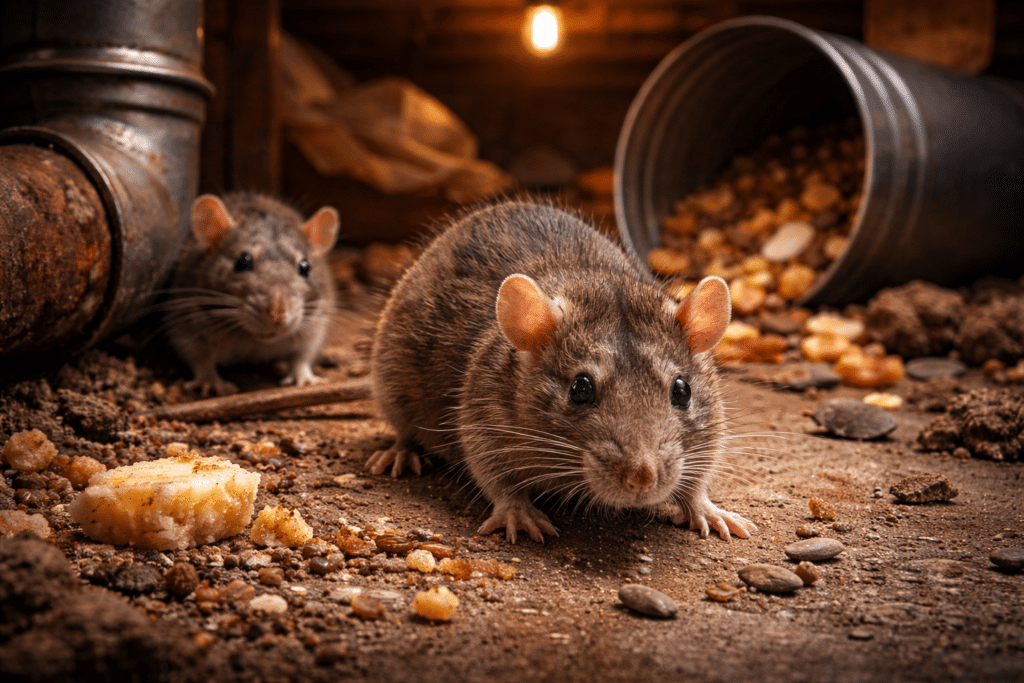
As a mom, I am typically starting to think about Spring cleaning right about now. I am always hoping I do not find evidence of mice in my garage, as I am going through storage searching for my children’s sports gear. One of the things that really grosses me out is mouse droppings. One mouse can produce upwards of 40 droppings in a day. If you are like me you have some questions.
Why my home?
Mice typically will come into a home looking for food and shelter. While most people think that mice are only a concern in the winter, rodents are active throughout the year. Grass seed, Bird seed, and pet food are often stored in garages. Storing these food sources in sealed containers is a great start. Mice like to stay within 10-20 feet of a food and water source. Condensation from an HVAC line or refrigeration system can provide enough water for mice to sustain life but we are not going to get rid of air conditioning, so eliminating access to food is essential. Mice can travel through areas as small as a dime. Storing food in sealed containers is going to be the easiest, low-cost deterrent you can do to help your uninvited guest to find another place to live.
What about disease and damage?
Mice and rats are associated with over 30 diseases, including Salmonella. Fleas and ticks are vectors, able to spread disease, and can hitchhike on rodents. Mice, like all rodents, spend part of their day gnawing. This means everything from electrical wiring to stored paper are susceptible to damage. Food loss and contamination is often reported. Mice have damaged ketchup packets, macaroni boxes, bags of flour, and cereals to name a few. The best way to prevent an infestation is by sealing up available food sources in sealed containers, such as Tupperware. The original container or bag the food is purchased may not be sufficient or preventing mice from becoming interested and damaging the food product. Once mice are enter an area, such as your garage or pantry, they leave behind pheromones.
Why are we talking about pheromones?
Rodents use pheromones to communicate with each other. This is very similar to a dog at a fire hydrant. Other dogs know that the first dog has been there and are encouraged to participate. Once mice have entered your home, there are pheromones present in your home. It takes time for the pheromone strength and presence to wain away. The pheromone eventually go away but that is mainly dependent on the mouse population and the length of time the infestation occurred.
Can I seal up my house from mice?
Exclusion is sealing areas so that a pest cannot enter. Exclusion will serve you better as a preventative measure before an infestation occurs. This is because rodents will gnaw at an area that has been sealed but has their pheromone present. This is very frustrating for homeowners. Mice teeth typically score about 5.5 on the Mohs hardness scale. Iron has been known to be as low as 4.5 on the Mohs hardness scale. Exclusion work should be done by a professional to avoid headaches and financial loss. Sealing up mice from the inside of your home is generally ineffective. Exterior exclusion work is the most effective. Enclosed or sealed crawlspaces do not prevent mouse infestations as seen in the picture below. Mice have chewed around the pipe and the “grease” mark from traveling in and out of the area can be seen.
How many mice are we talking about?
Mice are very prolific breeders. Depending on the research you find, they have been known to start breeding after 6 weeks of age. They usually are multiple pairs of pups. This means that it is not uncommon to have a litter of 4, 6, or even 8. Another litter of pups can occur every three weeks. Depending on the species, this can happen up to ten times a year. Mice also have a special ability called superfetation. This means that a mouse can get pregnant a second time while already pregnant. It is easy to see how a mouse population can get out of hand quickly.
How do I get rid of the mice?
A lot of people will spend money on do-it-yourself pest control. There is a science behind solving mouse problems and that takes time to research the right solutions. If you are ready to get family focused help, we at Invicta Pest Control are here to help. We have a options to customize mouse control for your home. Our most popular options involve tracking mouse activity through bait and a blacklight. This allows our technicians understand where the mouse are traveling to and from, which indicates nesting areas. Our newest feature is our electronic monitoring system. We place stations throughout your home that timestamp when and how much activity is occurring. With the help of Bluetooth technology, the technician gets a report of all activity since the last service of your home, typically just moments after pulling up in your driveway! This helps us understand susceptible areas of your home, concentrate our services, and put you at easy knowing the Mom-Owned, Family Focused pest control company is using the newest technology and best expertise to solve your mouse problem. We would love to help you get back to making your own family focused moments.
Related reading: Rodent Issues in Raleigh, NC and Winter Pest Risks.
Related Reading
- Venomous Snakes in Raleigh, NC: What You Actually Need to Worry About — rodent activity is one of the biggest snake attractants.
- Rodent Issues in Raleigh, NC
For additional rodent prevention guidance and our service details: our rodent control service | CDC: Preventing Rodent Infestations.
Frequently Asked Questions
How do mice get into Raleigh homes?
Mice can squeeze through any gap larger than 1/4 inch — roughly the diameter of a pencil. The most common entry points in NC homes are gaps around HVAC penetrations, dryer vents, gable vents, crawl space vents, garage door seals, and where utility lines enter walls.
How fast do mice multiply?
A single female house mouse can produce 5-10 litters per year of 5-6 pups each. That is up to 60 offspring annually from one mouse, and those offspring can begin reproducing at 6-8 weeks old. A small problem becomes a major infestation in months.
What attracts mice to a house?
Easy access to food (open pet food bags, crumbs, pantry items in cardboard), water (leaky pipes, pet bowls), and shelter (clutter, undisturbed storage areas, insulation). Eliminating those three things is the foundation of any successful mouse-prevention strategy.
Do ultrasonic mouse repellers work?
Independent research consistently finds ultrasonic devices ineffective for long-term rodent control. Mice habituate to the sound within days. Trapping plus exclusion (sealing entry points) is the only reliable approach.